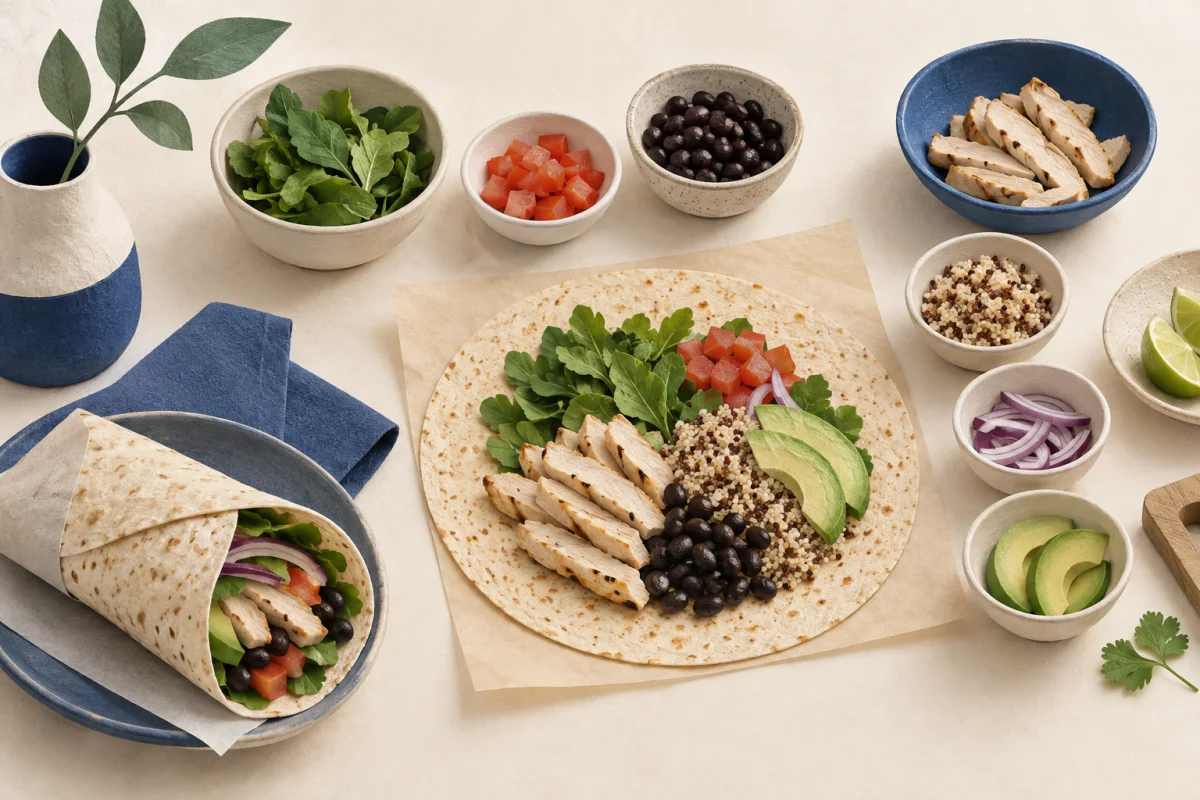
Before logging a wrap, bowl or sandwich, decide what the selected food entry includes. Either record a matching complete item or build it from ingredients. Combining both methods without checking the boundary can count the same protein twice.
Name the item you are trying to represent
A restaurant’s named chicken wrap and a generic database entry called “chicken wrap” may describe different foods. Look for the portion size, preparation, filling and any included sauce. A familiar title alone does not establish a match.
For a homemade meal, an ingredient list may be easier to audit. Write what was actually added, including the bread, cheese or beans, rather than logging only the ingredient you think of as the protein source.
Draw a boundary around the saved entry
Use a small inclusion checklist before adding extras. If the complete item already includes cheese, a separate cheese row counts it again unless you had an additional portion. If the description is unclear, leave a note instead of guessing that the entry is exact.
| Part | Already inside complete entry? | Action |
|---|---|---|
| Chicken | Yes | Do not add again |
| Tortilla | Yes | Do not add again |
| Standard cheese | Yes | Do not add again |
| Extra beans | No | Add actual extra portion |
| Sauce substitution | Unclear | Note mismatch; seek matching entry |
Suppose a matching complete wrap is listed as 28 g protein and a separately added bean portion contributes an estimated 5 g. The combined estimate is 33 g. Adding another 20 g chicken row would be a duplicate if that chicken was already included in the 28 g.
Use one method when the complete item does not match
If you remove several ingredients or build a different meal, replace the whole-item estimate with a component record. Do not keep the original full item and also add the reconstructed meal underneath it. Retain the old note if you need an audit trail, but mark which version is used in the daily total.
Match each component to its recorded state: a cooked food weight needs an appropriate cooked entry. Unknown portions remain estimates. Precise multiplication cannot repair an ingredient description that does not match.
Finish with a checkable meal note
A compact record can read: “Homemade wrap; ingredient method; chicken estimated from cooked entry; tortilla from package; beans measured; sauce quantity approximate.” That is more useful than an unexplained exact-looking total.
Keep the amount of food and grams of protein in separate fields. The protein portion guide covers that distinction. This method organizes a record; it does not decide how much protein you need or whether the meal meets all nutritional needs.
Check a saved favourite after substitutions
A saved meal can become inaccurate when the filling changes but the name stays the same. Before reusing it, check the ingredient boundary and the portion. If you replace chicken with beans, do not keep the chicken-containing complete entry and add beans on top. Create a revised meal description. Keep the earlier version if it represents meals already recorded, so the correction does not silently rewrite your history.
Use the free resources
The protein resource page has related guides and tools. Use paper if that is easier; the article’s worksheet does not require an account or an app. Keep personal notes on your own device and share only the information needed for your question.
Sources & checks
- USDA FoodData Central: data and food descriptions ↗
Food identity, preparation and data source matter when selecting a database record; not a personalized diet recommendation.
- FDA: understand the Nutrition Facts label ↗
Nutrition amounts use the stated serving basis. The recipe, portion and comparison calculations are original arithmetic examples, not measurements of real foods.
Checked against these sources on 2026-09-30. Source and editorial check: September 30, 2026. Worked examples and worksheets are original illustrations. This is not clinician-reviewed medical advice. This is educational content, not individual medical advice or a clinician-reviewed treatment plan.
Our editorial process · Suggest a correction