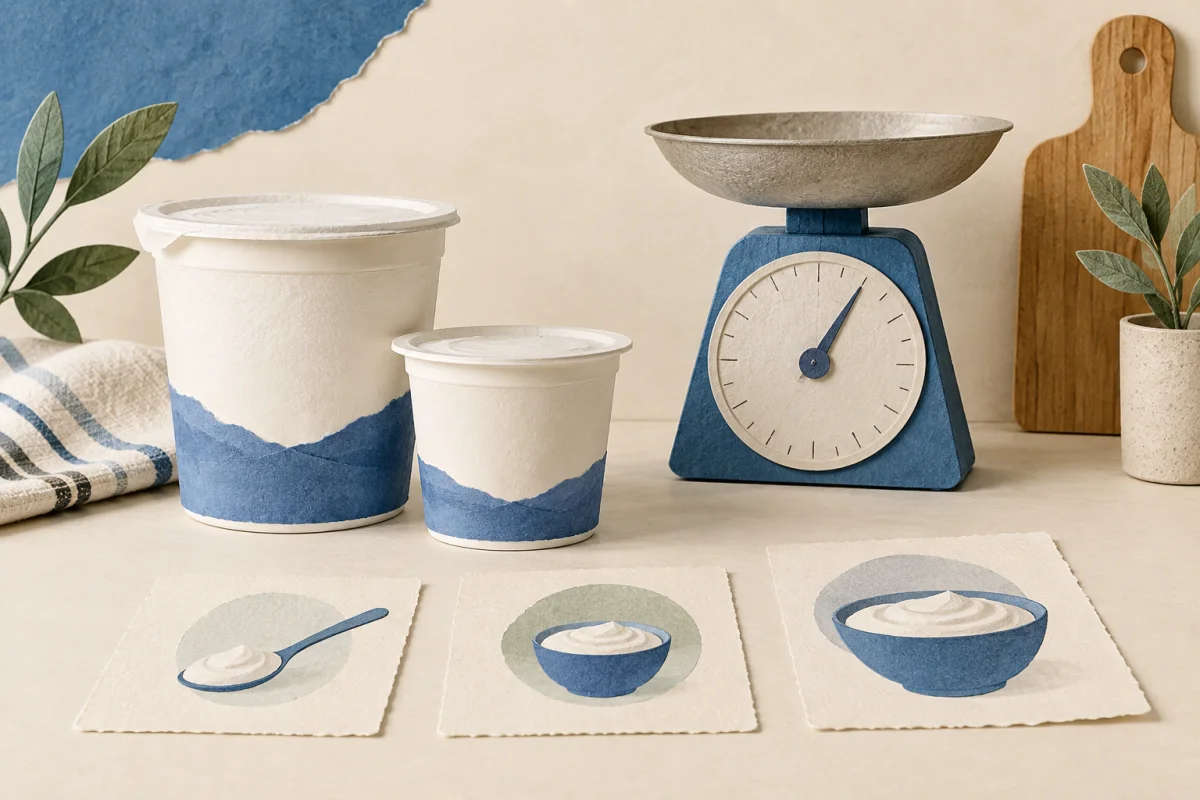
A protein number needs a food quantity beside it. Before comparing two claims, check whether each refers to a serving, the whole container or 100 grams. Then compare the same amount of food.
Find the quantity behind the headline
A tub may display one protein amount prominently while its nutrition panel uses a different quantity of food. Different numbers do not by themselves prove that either is wrong. Look for nearby wording such as “per pot,” “per serving” or “per 100 g,” including any preparation instructions.
FDA guidance explains that Nutrition Facts information is usually given for one serving, while some packages also show a per-package column. A labeled serving reflects typical consumption under US rules; it is not a personal recommendation for how much to eat.
Reconcile one package before comparing brands
Start with the panel’s food quantity and protein amount. Divide the quantity you want to check by the panel quantity, then multiply the protein by that ratio. Use grams with grams or milliliters with milliliters. A gram amount cannot be exchanged for a milliliter amount without product-specific information.
| Basis | Food quantity | Protein |
|---|---|---|
| Nutrition panel | 100 g | 8 g |
| Front claim: whole pot | 200 g | 16 g |
| Amount used | 150 g | 12 g |
Show the arithmetic once
In this example, the pot contains twice the 100 g panel quantity: 200 ÷ 100 = 2, and 8 × 2 = 16 g protein. If you use 150 g, the factor is 1.5, giving 12 g protein. The 150 g is the weight of food, not the weight of protein.
If the numbers still disagree after aligning quantities, check whether one describes the product prepared with milk or another ingredient. Check the flavor and package version as well. If the mismatch remains unexplained, retain the label and ask the manufacturer rather than choosing whichever value suits a goal.
A usable saved entry reads: “Yogurt, current tub label; 8 g protein per 100 g food; used 150 g; estimate 12 g protein.” An entry reading only “yogurt 16” loses both the quantity and the unit.
Compare two foods for the question you actually have
For a concentration comparison, use the same food weight for both products. For a meal record, use the actual quantity of each food. Those comparisons can give different impressions because package sizes and amounts eaten differ. Label which comparison you made.
Do not treat the protein figure as a complete nutrition assessment. The table does not establish protein quality, suitability for an allergy, a personal requirement or a medically appropriate intake. Preserve other relevant label information if a dietitian is helping you choose foods.
Save a reusable entry without freezing it forever
Keep the brand, flavor, quantity basis and date with a saved food entry. When the package changes, recheck those details before reusing it. A barcode match can help locate an entry, but the current physical label is still useful for checking its basis.
The protein portion tool supports this arithmetic, and the portion-record guide covers raw-versus-cooked descriptions. Use the free record or optional app to preserve the source. A missing panel value should stay unknown rather than become zero.
Sources & checks
- FDA: Serving size on the Nutrition Facts label ↗
Serving and container columns; serving sizes are not recommendations.
- Current App Store listing: Protein Tracker+ ↗
Public US listing checked September 30; recording or sound features only, not evidence of health benefit.
Checked against these sources on 2026-09-30. Examples and worksheets are original illustrations, not real patient histories or clinical validation. This is educational content, not individual medical advice or a clinician-reviewed treatment plan.
Our editorial process · Suggest a correction