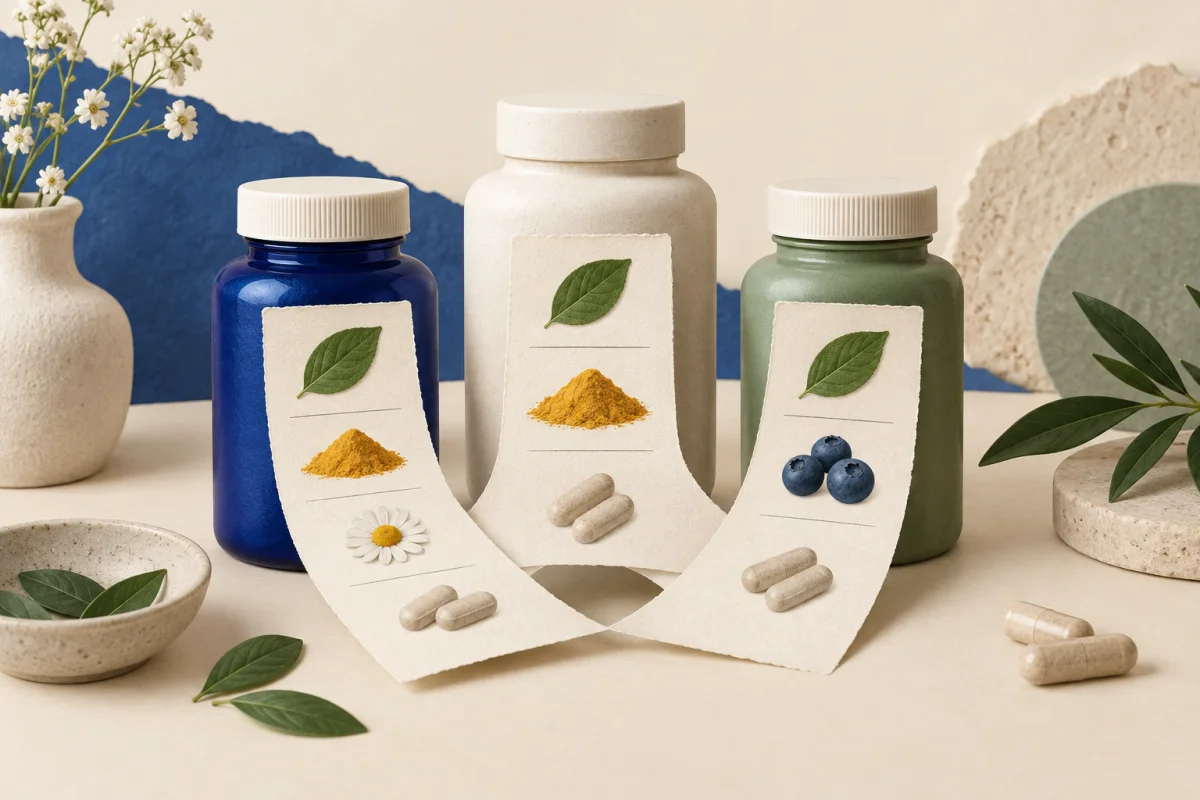
To find repeated supplement ingredients, compare the ingredient panels across all products you use, not just the names on the front. An overlap list is a question for a pharmacist or clinician; it does not by itself show that the combination is safe or harmful.
Gather the actual products
Include multivitamins, single-ingredient products, gummies, powders and occasional supplements. Photograph the current labels or bring the containers. Write the serving size and what you actually take, because a listed serving may contain more than one tablet or scoop.
Keep medicines in the review too. A supplement-only list cannot answer an interaction question that also involves prescribed or over-the-counter medicines.
Make one row per repeated ingredient
Start by matching the printed ingredient name. Copy its form and unit as written. If names or units differ, mark them for review rather than deciding that they are interchangeable. Do not combine milligrams, micrograms, IU or compound weights without an appropriate ingredient-specific explanation.
| Product | Label entry | Actual use | Question |
|---|---|---|---|
| Multivitamin A | Vitamin D, 10 micrograms per tablet | One tablet on recorded days | How does this combine with B? |
| Vitamin D product B | 25 micrograms per capsule | Frequency to confirm | Is this combination intended? |
| Mixed powder C | Ingredient list not yet copied | Occasional | Bring label before totaling |
For a day when one A tablet and one B capsule were actually taken, their labeled vitamin D amounts sum to 35 micrograms. That arithmetic does not establish an appropriate daily amount, and it excludes anything still unknown in product C.
Separate a product inventory from a daily total
Owning two products does not mean taking both every day. Record the relevant dates or usual pattern separately. A stopped supplement can remain on a history list with a stop date, but should not be counted as current use without explanation.
If a product has a proprietary blend, the label may not provide separate quantities for every ingredient. Preserve that limitation. Do not invent the missing breakdown from the order of ingredients.
Bring a short, answerable request
Ask: “Which ingredients overlap, which combinations need changing, and what written plan should I follow?” Include why you started each product and who recommended it, if known. Do not stop prescribed treatment or add another product to correct a perceived gap on your own.
Use the supplement appointment list for the full inventory. This additional worksheet highlights overlap so the reviewer can focus on the question, while the original labels remain available.
Do repeated names always mean equivalent quantities?
Not necessarily. A label may name an ingredient form, an elemental amount or a blend, and different panels can present those details differently. Copy the wording rather than stripping it down to a familiar nutrient name. A pharmacist can resolve whether two entries can be added. Keep the overlap flag even when the total is unresolved; identifying a question is useful without manufacturing the answer.
Use the free resources
The vitamins resource page has related guides and tools. Use paper if that is easier; the article’s worksheet does not require an account or an app. Keep personal notes on your own device and share only the information needed for your question.
Sources & checks
- NIH ODS: Dietary Supplements—What You Need to Know ↗
Supplement labels identify ingredients and serving amounts; share supplement use with healthcare professionals.
Checked against these sources on 2026-09-30. Source and editorial check: September 30, 2026. Worked examples and worksheets are original illustrations. This is not clinician-reviewed medical advice. This is educational content, not individual medical advice or a clinician-reviewed treatment plan.
Our editorial process · Suggest a correction