Record each reading separately, including systolic and diastolic pressure in mmHg. Keep the same measurement routine and follow your clinician’s schedule.
Make the measurement comparable
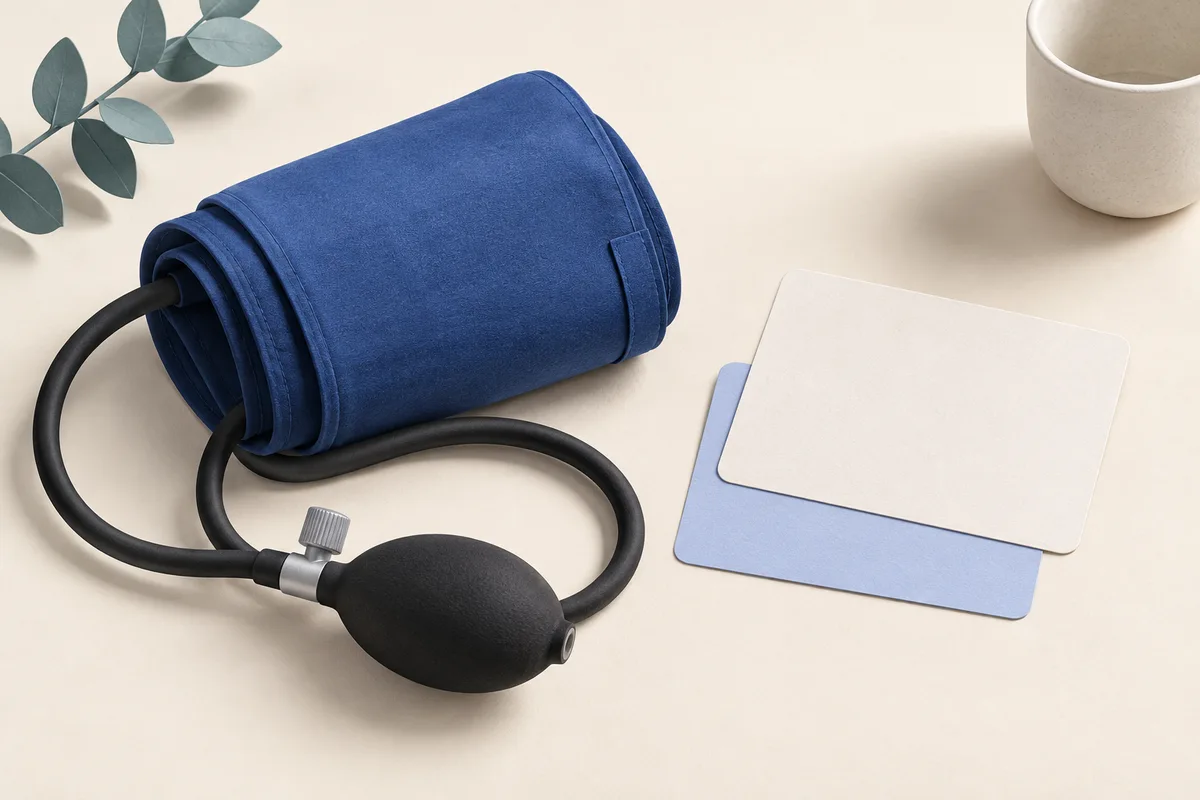
The American Heart Association advises a suitable upper-arm monitor, a correctly fitting cuff, and quiet rest before measurement. Sit with your back supported, feet flat, and arm supported at heart level. Follow the device instructions and ask a professional to check your technique.
The AHA recommends two readings one minute apart at each measurement session. Your clinician can tell you how often and when to measure. More measurements are not automatically more useful.
Keep the pair, not just the nicer number
Give the readings separate rows with the same session note. Do not discard a result just because the next one looks preferable. If the device shows an error, record the error rather than entering an invented number.
Example layout: 08:10 — reading 1 — 128/79 mmHg. 08:11 — reading 2 — 125/78 mmHg. Note: seated, after resting. These sample numbers are not personal targets.
Add a note when the routine changes
A short note such as “rushed upstairs immediately beforehand” or “different cuff” can help explain why a session may not be comparable. Keep the original result with that context.
If you export the log, leave units in the column headers and include the dates. Tell your clinician about gaps rather than treating them as normal readings. Ask whether they want raw readings, a particular averaging method, or both.
Know when the log is not the priority
If a reading is higher than 180 systolic and/or 120 diastolic, the AHA advises repeating it after at least one minute. If it remains that high, contact a healthcare professional immediately. With symptoms such as chest pain, shortness of breath, weakness, or difficulty speaking, call your local emergency number.
Do not adjust or stop prescribed medication based on this log. A record supports professional care; it does not replace it.
Sources & checks
- American Heart Association: home blood pressure monitoring ↗
Measurement technique, recording repeated readings, and when to seek urgent care.
- Current App Store listing: Blood Pressure Tracker° ↗
Checks the companion app’s stated features and its limitations; not independent evidence of health benefits.
Checked against these sources on 2026-09-20. The worked examples and record layouts are original illustrations. They are not real patient records or evidence of treatment effectiveness. This is educational content, not individual medical advice or a clinician-reviewed treatment plan.
Our editorial process · Suggest a correction