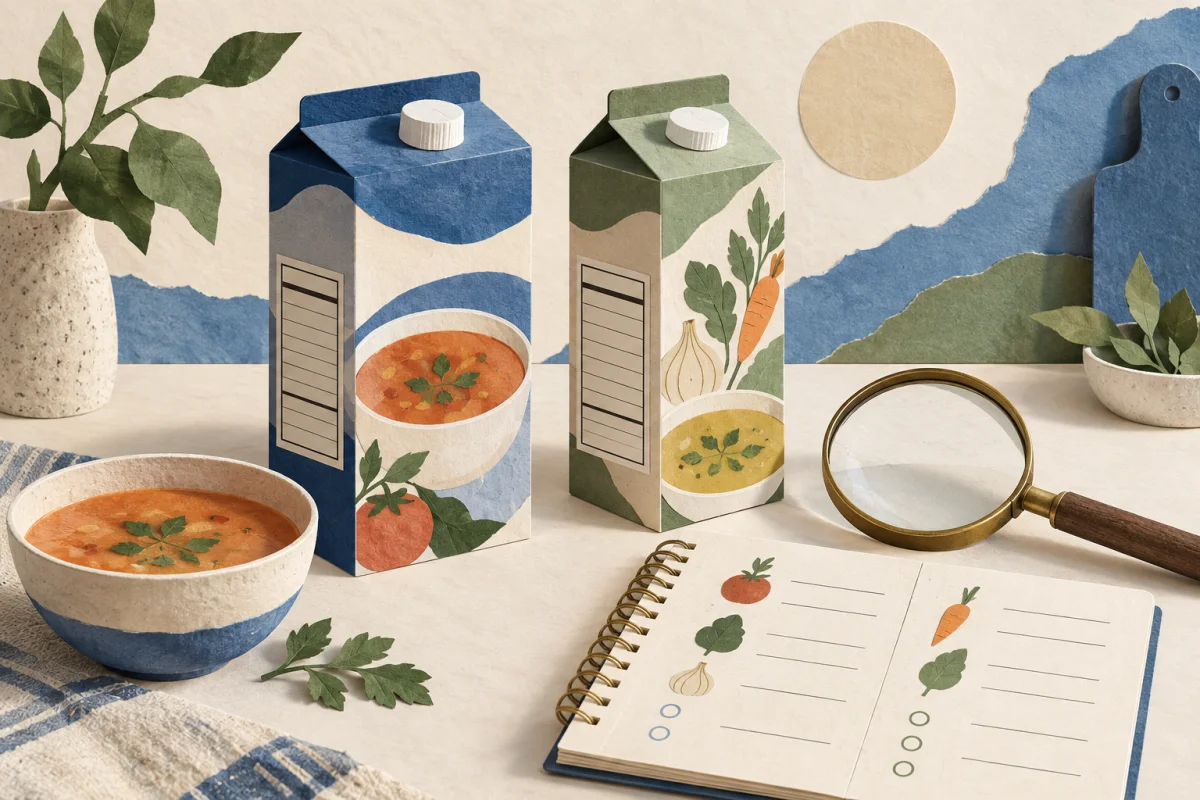
On US labels, reduced sodium is a comparison with a reference food. It does not automatically mean low sodium. Check the sodium amount, serving size and how much you expect to use before choosing between products.
The front of the pack answers only part of the question
A claim can describe a reduction, an amount or how a product was made. Those are different kinds of information. The FDA explains that “reduced sodium” means at least 25 percent less than the regular product, while “no salt added” does not necessarily mean sodium-free. Its consumer guidance describes low sodium as 140 milligrams or less per serving. These are US labeling explanations; do not transfer them to another country’s packaging rules.
The key reading habit is to connect the claim to the Nutrition Facts panel. A percentage reduction tells you something about a comparison product, but you still need the resulting sodium amount to compare two different foods.
Put both products on the same basis
Write the sodium in milligrams and the labeled serving quantity for each product. If the serving sizes differ, choose a common quantity that makes sense for the comparison and calculate each amount for that quantity. Retain the package values so another person can follow the arithmetic.
Do not compare a whole carton with half a carton or a dry mix with a prepared serving. Check whether the label describes the product as sold or prepared with additional ingredients. If you cannot resolve the basis, mark the comparison incomplete rather than assigning a winner.
| Product | Front claim | Sodium for 250 mL |
|---|---|---|
| A regular soup | No reduction claim | 720 mg |
| A reduced version of A | 25% less than A | 540 mg |
| B, another soup | No claim in this example | 430 mg |
Work through the comparison, not just the claim
In the invented example, 25 percent of 720 mg is 180 mg. Subtracting 180 from 720 leaves 540 mg, so the reduction arithmetic is consistent. Yet the different soup B contains 430 mg for the same quantity. The reduced claim has not told you which of all available soups contains the least sodium.
That comparison is only about sodium for the stated amount. It does not establish the best overall product for a person, account for allergies or preferences, or set a daily allowance. If you have a prescribed nutrition plan, use its instructions and discuss uncertainties with the professional who provided it.
If you use 375 mL of product B, the quantity multiplier is 375 ÷ 250 = 1.5. Its label-based estimate is 430 × 1.5 = 645 mg. Keep “375 mL used; label 430 mg per 250 mL” with the estimate. These are fictional labels, not product recommendations.
Watch for changes after opening the package
A no-salt-added ingredient can be combined with salty stock, sauce or toppings. Keep those additions separate if you are estimating a recipe. Conversely, do not assign an arbitrary sodium reduction because you drained or rinsed a food; use preparation-specific information when it is available.
Photographing or copying the current panel can help when brands change recipes. Keep the date and package size with the reference. A saved entry from an older container may be convenient, but the same product name is not proof that the current panel is identical.
Finish with a comparison you can explain
Your final note should name the product, the common comparison quantity, the sodium amount and any unresolved preparation issue. If you later record what you ate, replace the comparison quantity with the amount used; do not mistake the comparison for consumption.
Use the sodium label tool or serving-size guide for portion arithmetic. The free sodium record and optional app can preserve estimates. Neither a front-label claim nor a tracker can determine your personal sodium target.
Sources & checks
- FDA: Sodium in your diet ↗
US label claim definitions and reading sodium per serving.
- Current App Store listing: Sodium Tracker+ ↗
Public US listing checked September 30; recording or sound features only, not evidence of health benefit.
Checked against these sources on 2026-09-30. Examples and worksheets are original illustrations, not real patient histories or clinical validation. This is educational content, not individual medical advice or a clinician-reviewed treatment plan.
Our editorial process · Suggest a correction