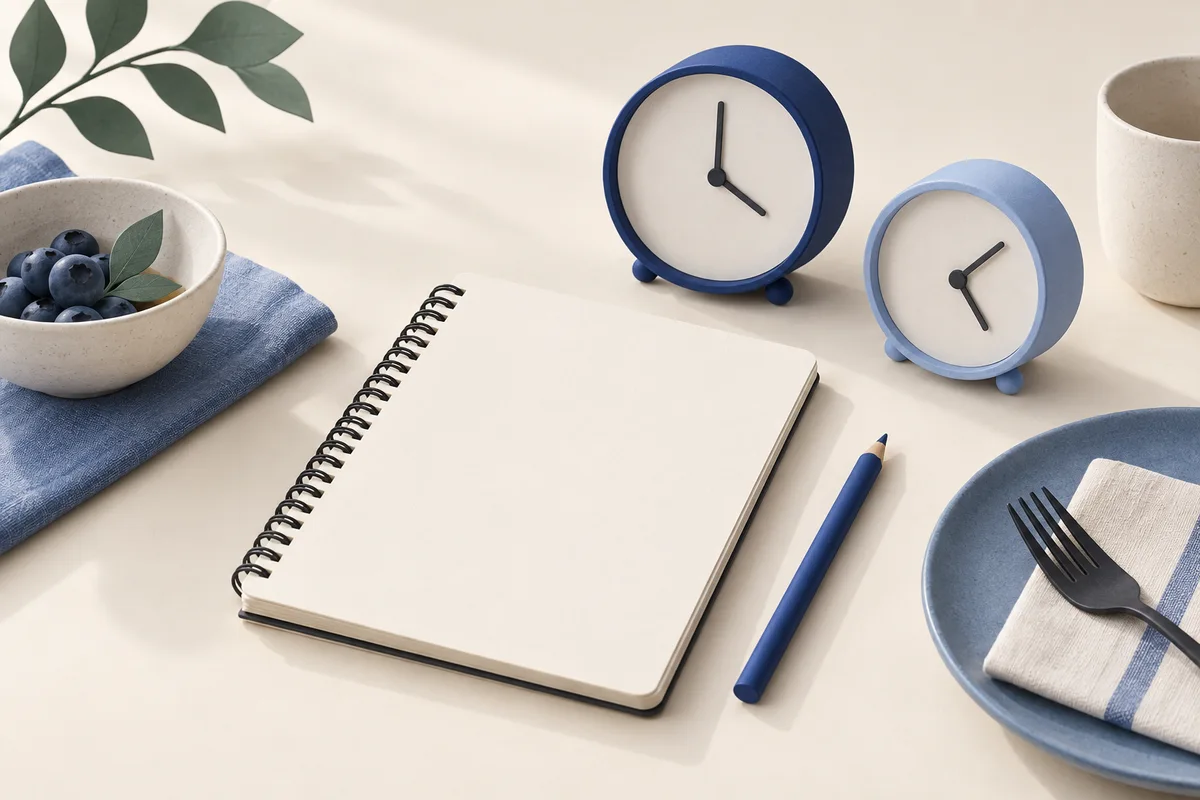
Record the actual first and last eating times, and label uncertain times. A longer gap is not automatically a better result.
Record what happened, not the intended streak
If your plan and the day differ, record the actual times. A log is a description, not a score. Do not change an entry to preserve a streak.
Decide what the fields mean before using them. If you are recording meals only, label the record that way; it may not include every drink or snack.
Keep overnight dates clear
An eating window that crosses midnight needs dates as well as times. “00:30” belongs to a different calendar day from the previous evening. Preserve that distinction in exports.
Example: last meal Tuesday 20:15; first meal Wednesday 08:00. These times illustrate date handling, not a recommended fasting schedule.
Put sleep and symptoms beside the timing
A short note can explain a changed routine, such as shift work or travel. Do not infer that the timing caused a symptom simply because they occurred together.
When traveling, state whether you used local time. Changing time zones can make an apparent duration misleading if the record does not identify the change.
Define the event before measuring the interval
Decide what the start and end fields mean for your record. “Last meal” might refer to the start of dinner, the end of dinner, or the last food consumed afterward. Those definitions produce different intervals. Write your definition in the cover note and use it consistently. This is a documentation choice, not a statement about what physiologically starts or ends a fast.
If you are recording meals only, make that explicit. Snacks or drinks may not be represented. Do not label the resulting gap as a complete record of all intake unless that is what you actually recorded. A timer can measure the interval between two taps but cannot establish what happened between them.
Check overnight arithmetic using complete dates
From Tuesday at 20:15 to Wednesday at 08:00 is 11 hours and 45 minutes: 3 hours and 45 minutes to midnight, then another 8 hours. Dates matter because subtracting only the clock times can produce a negative result or the wrong day. The elapsed-time tool on the hub asks for both dates and times.
Use it only for times in the same fixed time zone with no clock change. Travel and daylight-saving changes can make wall-clock subtraction differ from elapsed time. Keep the original time-zone information and mark the uncertainty instead of relying on this simple calculator for those cases. The arithmetic is not a recommended fasting duration.
| Situation | Record note |
|---|---|
| Ordinary overnight interval | Full start and end dates in the same time zone |
| Planned timer ended later than the meal gap | Actual meal time and timer time kept separate |
| Travel or daylight-saving transition | Time-zone or clock-change note; calculator not used |
Describe an interrupted plan honestly
If a day differs from a planned schedule, record what happened. Do not move a meal time to preserve a streak. You can keep the intended schedule in a separate note if it helps explain the difference, but the event history should stay tied to actual known times.
For a review, include the reason you are keeping the record and questions about how it fits your care. A change in energy or another symptom on the same day is context, not proof of a cause. The log does not recommend skipping a meal, changing medicine timing, or extending an interval. Follow clinical advice for your circumstances rather than treating the calculator result as a target.
Get individual advice before changing eating patterns
Fasting can create particular risks for people with diabetes, including those using medicines that lower glucose. NIDDK advises individual clinical planning; do not change medicine timing or doses based on a website.
The free log records timing only. Fastora offers a dedicated timing app, but neither this guide nor an app timer establishes that fasting is appropriate for you.
Sources & checks
- NIDDK: fasting safely with diabetes ↗
Fasting with diabetes can present risks, and medicine changes need individual clinical guidance.
- Current App Store listing: Fasting Timer Tracker: Fastora ↗
Checks the companion app’s stated features and its limitations; not independent evidence of health benefits.
Checked against these sources on 2026-09-20. The worked examples and record layouts are original illustrations. They are not real patient records or evidence of treatment effectiveness. This is educational content, not individual medical advice or a clinician-reviewed treatment plan.
Our editorial process · Suggest a correction