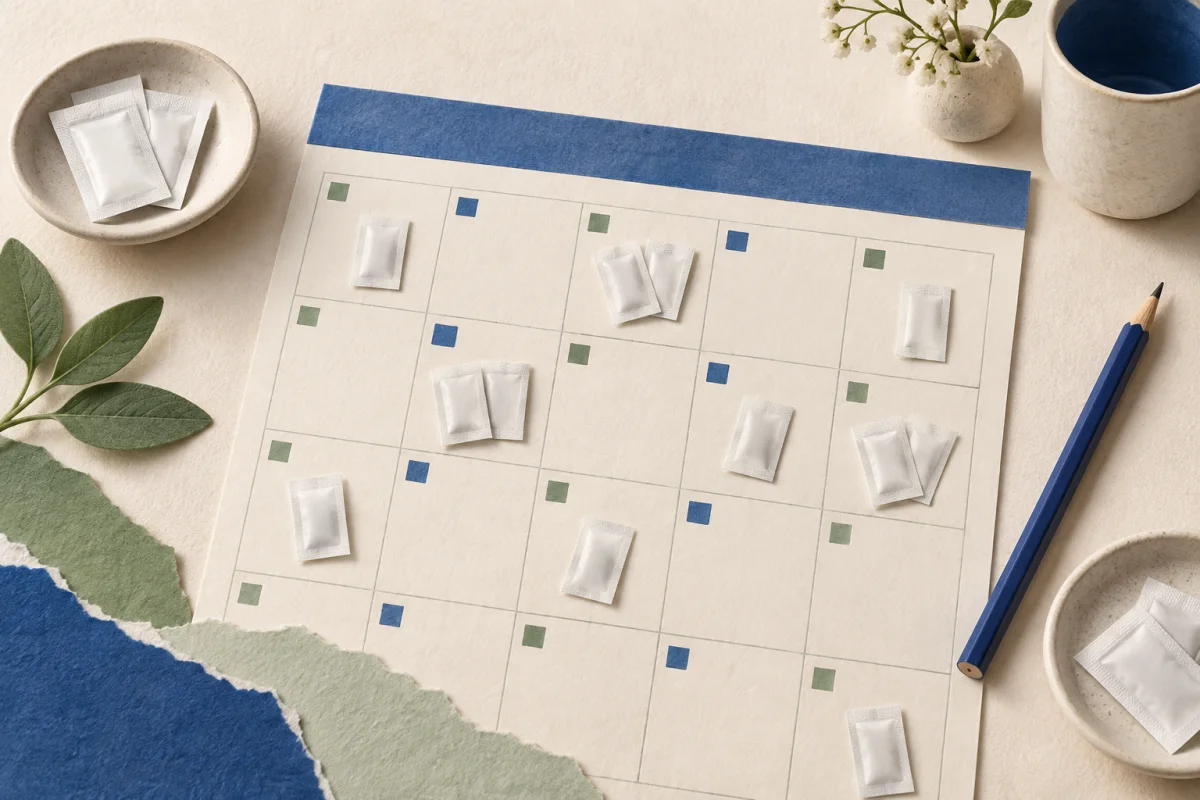
One day with several doses is one medicine-use day, but the doses still need their own record. For a headache review, preserve both measures and the medicine names. Do not use a diary count alone to diagnose medication-overuse headache or decide how to change treatment.
Start with the dates and the products
Write the medicine name, strength, amount taken and time when known. Include non-prescription products and combination products. If a label is unclear, bring the package or ask a pharmacist rather than guessing the ingredients.
A clinician may ask for separate counts by medicine or medicine group as well as the number of days on which any acute headache medicine was taken. Those counts answer different questions.
Count unique dates for each question
Make a date list before adding totals. A date appears once in the “any medicine” count even if two products were used that day. Keep the original dose entries so that a day count does not hide the actual use.
| Date | Recorded events | Any-use day? |
|---|---|---|
| Nov 1 | Medicine A twice | Yes |
| Nov 2 | No use recorded; day confirmed complete | No |
| Nov 3 | Medicine A once and medicine B once | Yes |
| Nov 4 | Diary missing | Unknown |
There are two confirmed medicine-use days and four recorded medicine-taking events. Medicine A appears on two dates; medicine B appears on one. Adding those product-specific day counts gives three, which would overcount the two unique dates with any use.
Keep incomplete coverage visible
A blank day is not proof that no medicine was taken. Mark it unknown unless you can confirm it. If a dose was taken after midnight, keep its actual date and time even if it related to a headache that began the evening before. Ask your clinician which counting convention they want for their review.
Do not extrapolate a partial week into a monthly total as if every unrecorded day followed the same pattern. Report the observed dates and coverage.
Use the summary to ask for a plan
Bring the product list, day counts and the underlying entries. Ask what pattern matters for your medicines and what to do if you need relief more often than the agreed plan allows. NICE includes medicine use in headache assessment, but clinical interpretation depends on more than a single number.
Do not stop, substitute or reduce prescribed medicines based on this worksheet. For the symptom side of the record, use the simple migraine diary. New, severe or otherwise concerning symptoms need medical attention rather than a more complete count.
What if the medicine was taken for another kind of pain?
Keep the medicine and date in the overall use record and add the reason as you remember it. Do not silently exclude it because the headache diary was the starting point. Ask your clinician which uses belong in their requested summary. A product can appear in more than one health context, and a clear reason column helps the reviewer interpret it without duplicating the actual dose event.
Use the free resources
The migraine resource page has related guides and tools. Use paper if that is easier; the article’s worksheet does not require an account or an app. Keep personal notes on your own device and share only the information needed for your question.
Sources & checks
- NICE: headaches in over 12s ↗
Headache diaries include frequency, duration, symptoms and medicines; medicine-use history informs assessment, not self-diagnosis.
Checked against these sources on 2026-09-30. Source and editorial check: September 30, 2026. Worked examples and worksheets are original illustrations. This is not clinician-reviewed medical advice. This is educational content, not individual medical advice or a clinician-reviewed treatment plan.
Our editorial process · Suggest a correction